Lp(a) and ApoB: what your cholesterol test might be missing
Two lesser-known blood markers can reveal cardiovascular risks that a standard cholesterol test may overlook, or provide welcome reassurance.


By Lauren Mason, PhD and Dr Jim Boersma
26 October 2026 · 6 min read
On this page
Many people know whether their cholesterol is high or normal. But cholesterol alone does not always tell us enough about the risk of heart disease. Two additional blood markers, apolipoprotein B (ApoB) and lipoprotein(a), or Lp(a), can make that picture clearer.
ApoB: why the number of particles matters
A standard lipid panel measures how much cholesterol is carried in the blood. LDL cholesterol (LDL-C) is useful, but it does not tell us exactly how many potentially harmful particles are circulating. Each LDL particle contains one ApoB molecule, so ApoB provides an estimate of their total number.
Two people can have similar LDL cholesterol levels but very different ApoB levels. A higher ApoB means more atherogenic particles circulating in the blood, each of which can enter the arterial wall and contribute to plaque formation (atherosclerosis). This helps explain why ApoB may be a better indicator of cardiovascular risk than LDL cholesterol alone.
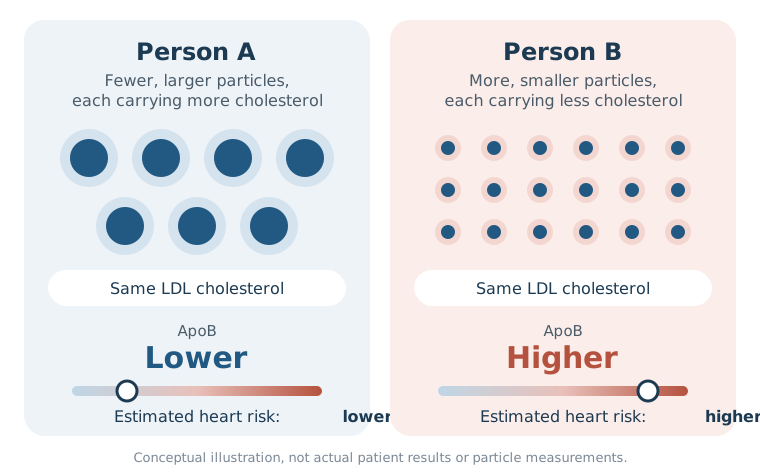
This difference is particularly common in people with insulin resistance, diabetes or elevated triglycerides, whose LDL particles often carry less cholesterol individually. Large population studies suggest that when ApoB and LDL cholesterol levels disagree, cardiovascular risk tends to follow ApoB more closely.¹
Lp(a): the risk factor you inherit
Lp(a) is an LDL-like cholesterol-carrying particle that can enter the arterial wall and contribute to plaque formation. It may also promote inflammation and blood clotting, further increasing cardiovascular risk.
Its concentration is largely determined by genetics, which means healthy eating and exercise have little effect on the level itself. Around one in five adults has elevated Lp(a), which is associated with an increased risk of cardiovascular disease and aortic valve stenosis, even when standard cholesterol results look reassuring.²
Because Lp(a) levels are largely determined by genetics, testing once in adulthood is usually sufficient. However, levels can vary over time, and repeat testing may be useful in certain circumstances, particularly when results are borderline or following significant health or hormonal changes.³
Yet testing remains remarkably uncommon. Large studies of US and European healthcare populations have reported annual testing rates below 0.5%, despite growing recognition of its importance.⁴⁻⁶ This represents a significant missed opportunity to identify cardiovascular risk before symptoms develop.
Who should test?
At Prevscan we include both tests for everyone, because we see them as at least as important as a conventional cholesterol test. In short:
- Lp(a): any adult who has never had it measured. Guidelines now suggest doing it at least once.⁷⁻⁸
- ApoB: any adult who wants to understand their health and cardiovascular risk more fully, and especially people with existing risk factors, such as:
- a parent, brother or sister who had a heart attack or stroke at a young age (before about 55 in men or 65 in women)
- a family history of high cholesterol or high Lp(a)
- insulin resistance, diabetes or high triglycerides, where LDL cholesterol can underestimate risk
- a previous heart attack or stroke despite "normal" cholesterol
What counts as a high result?
ApoB has no single "normal" value. Instead we use preventive targets: the higher your overall cardiovascular risk, the lower the ApoB you should aim for. Most people don't know what their overall risk is, or whether it counts as high or very high, which is why we always read ApoB alongside your other results and medical history.
| ApoB result | Preventive target |
|---|---|
| Below 65 mg/dL | Excellent |
| 65–80 mg/dL | Good |
| 80–100 mg/dL | Acceptable |
| Above 100 mg/dL | Elevated |
Lp(a) is reported in either nmol/L or mg/dL. Our lab uses nmol/L, so we show that first, with the approximate mg/dL figure in brackets. The two units can't be converted exactly.
| Lp(a) result | Cardiovascular risk |
|---|---|
| Below 75 nmol/L (about 30 mg/dL) | Low |
| 75–125 nmol/L (about 30–50 mg/dL) | Medium |
| Above 125 nmol/L (about 50 mg/dL) | High |
What Dr Jim sees in clinical practice
At Prevscan, Dr Jim Boersma often sees people who feel well and had no idea they might have increased cardiovascular risk. An unexpected ApoB or Lp(a) result can motivate practical changes, such as lifestyle improvements, or considering medication when appropriate.
One example from our practice involved a woman who felt healthy and had no known family history of cardiovascular disease. She had never had her cholesterol checked before. When we assessed her cardiovascular risk, we found markedly elevated LDL cholesterol, ApoB and Lp(a). These results came as a surprise, but they also provided an opportunity to act. She made changes to her lifestyle and, with medical guidance, started treatment to address her cardiovascular risk factors. Her cholesterol levels are now improving. Without testing, these risk factors might have remained undetected for years.
But testing can also bring relief. Some people are concerned because of their family history or a previous high-cholesterol result. Favourable ApoB and Lp(a) levels can help put those concerns into perspective. They do not cancel out other risk factors, but they can provide meaningful reassurance.
Preventive medicine is not only about discovering problems. Sometimes better information shows that the picture is more reassuring than someone feared.
What if your result is elevated?
An elevated ApoB may strengthen the case for lowering atherogenic lipoproteins through diet, activity and, when appropriate, medication. Lp(a) is harder to change directly, but its associated risk can still be addressed by managing LDL cholesterol, blood pressure, smoking and other modifiable factors.
Treatments targeting Lp(a) specifically are currently under investigation. Lowering the laboratory number is not yet the same as proving fewer heart attacks or strokes.
Why Prevscan includes both tests
International guidelines increasingly recommend measuring Lp(a) at least once in adulthood. ApoB is also gaining recognition as a valuable measure of cardiovascular risk, although LDL-C remains central to many treatment guidelines.⁷⁻⁸
At Prevscan, both ApoB and Lp(a) are routinely included in our Core, Advanced and Women's Health Assessments. We use them alongside conventional cholesterol results, medical history and other risk factors: not as stand-alone verdicts, but as part of a more individualised assessment.
Good preventive medicine is not about finding something wrong with everyone. It is about understanding your risk and making informed decisions about your health.
References
- 1.Johannesen CDL et al. Discordance among apoB, non-HDL cholesterol, and triglycerides: implications for cardiovascular prevention. European Heart Journal (2024).
- 2.Patel AP et al. Lp(a) concentrations and incident atherosclerotic cardiovascular disease: new insights from a large national biobank. Arteriosclerosis, Thrombosis, and Vascular Biology (2021).
- 3.Awad K et al. Intra-individual variability in lipoprotein(a) levels: findings from a large academic health system population. European Journal of Preventive Cardiology (2025); 32(9):716–721.
- 4.Stürzebecher PE et al. Trends and consequences of lipoprotein(a) testing: cross-sectional and longitudinal health insurance claims database analyses. Atherosclerosis (2023).
- 5.Bansal A, Cho L. Prevalence of lipoprotein(a) testing in a contemporary cohort. Circulation (2025).
- 6.Hanif M et al. Global lipoprotein(a) testing trends from 2015 to 2023. American Heart Journal (2025).
- 7.ESC/EAS. 2025 Focused Update of the 2019 Guidelines for the Management of Dyslipidaemias.
- 8.National Lipid Association. A focused update to the 2019 NLA scientific statement on use of lipoprotein(a) in clinical practice (2024).
About the authors
Epidemiologist & health strategist
Lauren has a PhD in Immunology and more than 15 years in medical research. At Prevscan she evaluates the evidence behind prevention and turns it into clear next steps.
Family physician & founder
Jim is a Dutch family physician on the Costa Blanca and the founder of Prevscan. He reviews every investigation and explains the results personally.
Find out where you stand
Health checks, from bloods to full-body MRI
Core and Advanced packages at HCB Dénia, with every result explained by your doctor.